
A bipartisan US body claimed that religious freedom conditions in India remained on the downward trajectory in 2026, citing restrictions on activities of NGOs, censorship and transnational repression.
The Indian government has dismissed the US Commission on International Religious Freedom's (USCIRF) report on religious freedom in India, stating that it does not recognise the commission's authority to comment on the rights of Indian citizens.

A nine-judge Supreme Court bench has reserved its order on petitions related to discrimination against women at religious places, including the Sabarimala temple, and the scope of religious freedom.
India has strongly rejected remarks by the US Commission on International Religious Freedom (USCIRF) officials calling for sanctions against the Rashtriya Swayamsevak Sangh (RSS) and advising against diplomatic courtesies for its leaders. The External Affairs Ministry spokesperson labelled USCIRF a "biased" organisation with its own agenda, lacking credibility.

A US Congress-constituted advisory body on religious freedom, the USCIRF, has urged the Trump administration to revoke the visa issued to RSS chief Mohan Bhagwat, citing concerns over alleged violent attacks against religious minorities by RSS subgroups.

Security personnel reportedly justified the action due to child theft concerns and identity verification.

The US Commission on International Religious Freedom (USCIRF) has recommended sanctions against the Rashtriya Swayamsevak Sangh (RSS) and advised the US government against extending diplomatic courtesies to its leaders. This comes ahead of RSS Chief Mohan Bhagwat's visit to the US, with USCIRF officials citing allegations of attacks on religious minorities by RSS sub-groups. India has consistently rejected USCIRF's reports as biased and selective.

In an unusually hard-hitting response to criticism against it in a United States government report on religious freedom, India on Friday described the findings as 'deeply biased', visibly driven by 'votebank' considerations and a mix of imputations and selective usage of facts.
In its annual report on religious freedom, the USCIRF asked the US State Department to designate India as a "country of particular concern" on the status of religious freedom along with several other nations.

The Supreme Court is set to scrutinise a significant plea by Carnatic vocalist T M Krishna challenging the penal law mandating Vande Mataram singing, raising crucial questions about secularism, fundamental rights, and national honour in India.
Coming on the heels of two successful bilateral meetings between Prime Minister Narendra Modi and President Joe Biden -- the Official State Visit of the Indian leader here in June and a bilateral meeting in New Delhi in September -- USCIRF in its announcement of the meeting said the Congressional hearing is on how the US government can work with the Indian government to address violations.

The Chinese government is restricting individuals, in particular those of the minority community, from their religious practices, US Secretary of State Hillary Clinton said Tuesday.

"Our principled position remains that we see no locus standi for a foreign entity to pronounce on the state of our citizens' constitutionally protected rights," Spokesperson in the Ministry of External Affairs Anurag Srivastava said.

The Supreme Court of India has stated that religious institutions must have structure and norms for their functioning, emphasising that the right to manage a religious institution does not imply an absence of order.

The US Commission for International Religious Freedom (USCIRF) also recommended to the Congress to raise the issue of religious freedom during US-India bilateral meetings, and hold hearings on it.

The BJP has criticised the Allahabad High Court's observations regarding the wearing of a hijab in school, stating that such matters should be left to school administrations and not courts. BJP spokesperson Syed Zafar Islam argued that faith is a significant personal aspect and courts should not dictate personal attire, while also acknowledging that schools have the right to set uniform policies. The High Court had dismissed a petition seeking permission for a girl to wear a headscarf, ruling it's not an essential part of Islamic faith.
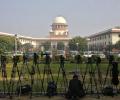
A nine-judge Supreme Court bench has commenced hearing on petitions related to discrimination against women at religious places, including the Sabarimala temple, and the scope of religious freedom across faiths.
The Supreme Court of India has dismissed the use of information from 'WhatsApp University' as evidence in a case concerning religious freedom and discrimination against women at religious sites, including the Sabarimala Temple.

Religious freedom in India was on a "negative trajectory" in 2015 as religious tolerance "deteriorated" and religious freedom violations "increased", a United States report on international religious freedom said
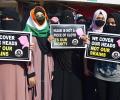
External Affairs Ministry Spokesperson Arindam Bagchi said the observation on India in the report is based on 'motivated inputs and biased views'.

Religious freedom and related human rights in India are under ongoing threat, the US Commission for International Religious Freedom alleged on Tuesday in an unusual year-end update of the status of its assessment of religious freedom in the country.
Taking note of the recent violence against the Christian community in India, the US has asked the Indian government to protect the religious freedom throughout the country. "We urge all parties to refrain from violence and urge government officials to protect religious freedom throughout India and thus preserve India's longstanding tradition of religious tolerance," said Ambassador for International Religious Freedom, John Hanford.
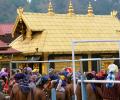
The Travancore Devaswom Board (TDB), managing the Sabarimala temple, argued in the Supreme Court that religious beliefs should be judged subjectively by the community, as the court hears petitions related to discrimination against women at religious places.
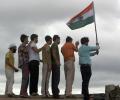
The report, released on June 21, alleged that some senior leaders of the BJP "made inflammatory speeches against minority communities".
In the 2020 edition of its annual report on International Religious Freedom, the US Commission for International Religious Freedom (USCIRF) alleged that religious freedom in India witnessed a drastic downward turn.

The Calcutta High Court has upheld a college's decision to deny an assistant professor appointment due to his social media posts, observing that the right to profess one's religion does not permit hurting others' faith. The court ruled that the college's decision was bona fide and in the institution's best interest, despite the candidate's claims of infringed freedom of speech and religion.
Putting India on the 'watch list' for the second year in succession, the US Commission for International Religious Freedom (USCIRF) in its report said the Indian government at various levels recognised the problem of communal violence and created some structures to address these issues.
Accusing China of repressing dissent, the US commission on global religious freedom has appealed to President Barack Obama to take up the issues of human rights and religious freedom during his meeting with his visiting Chinese counterpart Hu Jintao at the White House.
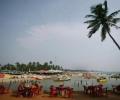
Two FIRs have been registered against Congress leader Girish Chodankar and tribal leader Govind Shirodkar in Goa for allegedly hurting religious sentiments, following protests by the Hindu Ekta Samiti.
External affairs ministry spokesperson Vikas Swarup said the government does not see the locus standi of a foreign entity like US Commission on International Religious Freedom to pronounce on the state of Indian citizens' constitutionally protected rights.
The Bill has been pending with the Governor for over a year after the Assembly passed it last April 6 amidst uproarious scenes and boycott by the opposition parties.
A US government report on Monday praised the religious freedom in India despite mentioning instances of attacks on religious minorities, and lauded the "independent" judiciary and a "vibrant" civil society for acting against violations whenever they occur.
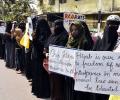
The Allahabad high court has dismissed a petition filed by a minor student of a school in Prayagraj. The petitioner had sought permission to wear a hijab additionally along with the prescribed school dress code while attending classes.
In a missive to Bush, USCIRF chair Felice D Gaer urged him to 'ask Prime Minister Singh to ensure the immediate security of Indian citizens -- security that is undermined by recurrent attacks on religious minorities and communities.'

A US Congressman has raised serious concerns regarding India's proposed amendments to the Foreign Contribution Regulation Act (FCRA), warning that these changes could lead to government takeovers of religious charities and strain bilateral relations.
A US Congress-constituted quasi-judicial body on Monday recommended to the Biden Administration to designate India, China, Pakistan, Afghanistan and 11 other nations as "country of particular concern" in the context of status of religious freedom.

The announcement came as Secretary of State Rex Tillerson decided to re-designate about 10 countries as 'Countries of Particular Concern'.
The report praised the United Progressive Alliance government at the Centre for implementing an inclusive and secular platform that included respect for the right to religious freedom.

India has rejected a report by the US Commission on International Religious Freedom (USCIRF) that criticised India's record on religious freedom and called for linking US security assistance and trade to improvements in this area.
